


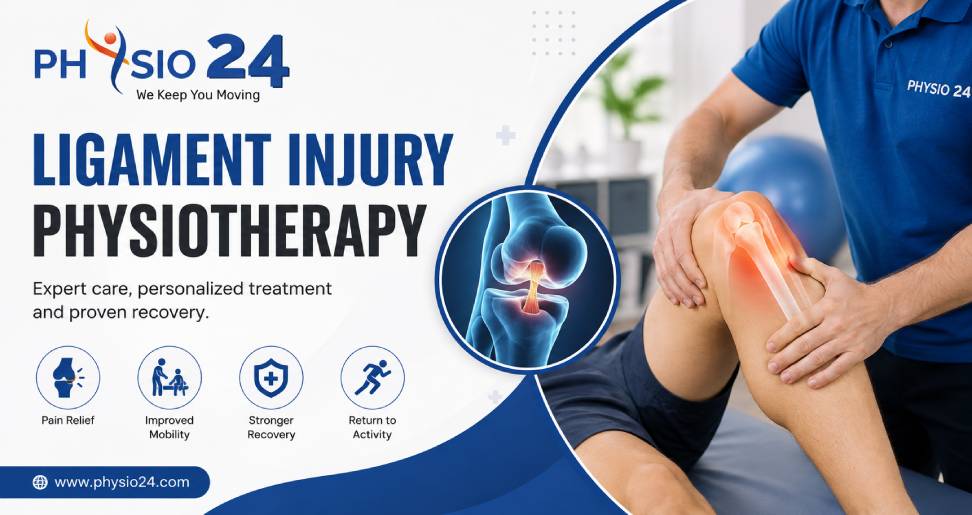
Ligament injuries are common among athletes, active adults, and people who experience sudden twists, falls, or impacts. A ligament is a strong band of connective tissue that connects bones and helps stabilize a joint. When a ligament is stretched or torn, it can cause pain, swelling, weakness, and difficulty moving the affected joint. Common examples include ankle sprains, knee ligament injuries such as ACL injuries, and injuries to the wrist or thumb.
Ligament Injury Physiotherapy plays an important role in restoring movement, rebuilding strength, improving joint stability, and helping patients safely return to everyday activities or sports. Physiotherapy is widely used for sprains and strains, while the exact rehabilitation plan depends on the severity and location of the injury.
What Causes Ligament Injuries?
Ligament injuries can happen when a joint is forced beyond its normal range of movement. Sports involving running, jumping, sudden stops, or changes of direction can increase the risk. Everyday accidents, falls, and awkward landings can also damage ligaments.
The severity can range from a mild stretch to a partial or complete tear. Symptoms may include pain, tenderness, swelling, bruising, reduced movement, weakness, and difficulty putting weight on the affected limb.
A significant ligament injury should be assessed by an appropriate healthcare professional because some injuries may require imaging, bracing, specialist assessment, or surgery.
How Does Physiotherapy Help Ligament Injuries?
The primary goal of Ligament Injury Physiotherapy is not simply to reduce pain. A good rehabilitation programme focuses on restoring the function of the injured joint and preparing it for normal physical demands.
Depending on the injury and stage of recovery, physiotherapy may include:
- Pain and swelling management
- Gentle mobility exercises
- Progressive strengthening
- Balance and coordination training
- Joint stability exercises
- Movement and gait retraining
- Sport-specific rehabilitation
- Education about activity modification
- A structured home exercise programme
For ACL injuries, rehabilitation commonly focuses on restoring range of motion, rebuilding quadriceps and other lower-limb strength, improving balance and proprioception, and gradually progressing functional activities.
Different Stages of Ligament Rehabilitation
1. Early Recovery
During the initial phase, protecting the injured area and controlling pain and swelling are important. Depending on the injury, a clinician may recommend temporary activity modification, compression, support, or reduced weight-bearing.
Once movement can be performed safely, gradual mobility is introduced to prevent excessive stiffness.
2. Strength and Mobility
As symptoms settle, physiotherapy can progress toward strengthening the muscles surrounding the injured joint. For example, knee ligament rehabilitation may involve strengthening the quadriceps, hamstrings, glutes, and calf muscles.
The objective is to improve the joint’s ability to tolerate everyday loading and physical activity.
3. Balance and Stability
Ligament injuries can affect proprioception—the body’s ability to sense joint position. Balance exercises and controlled movement drills can therefore become an important part of rehabilitation.
For active individuals, later stages may include jumping, running, changes of direction, and sport-specific exercises when clinically appropriate.
4. Return to Activity
Returning to sport or demanding physical activity should not be based solely on a calendar. Strength, movement quality, balance, confidence, symptoms, and functional performance should be considered.
After ACL reconstruction, for example, rehabilitation guidance emphasizes criteria-based progression and assessment of strength, hopping ability, agility, stability, and psychological readiness before returning to sport.
Chiropractic Care and Ligament Injuries
Chiropractic care commonly focuses on musculoskeletal problems and may include manual therapy, spinal manipulation, exercise, and other approaches.
For someone recovering from a ligament injury, chiropractic treatment should be individualized and coordinated with the overall rehabilitation plan. Manipulation is not a substitute for ligament rehabilitation, particularly when the injured joint requires progressive strengthening and stability training.
Spinal manipulation can have temporary side effects such as soreness or discomfort, and practitioners should screen patients carefully before treatment.
Osteopathic Manipulation
Osteopathic Manipulation is another hands-on approach used to address musculoskeletal function. Depending on the individual’s condition, an appropriately trained professional may use manual techniques to address movement restrictions or related musculoskeletal problems.
However, treatment should be selected according to the injury and recovery stage. For a ligament tear or sprain, manual treatment should complement—not replace—a progressive rehabilitation programme that addresses strength, mobility, balance, and functional capacity.
Dry Needling
Dry Needling may be used by appropriately trained clinicians as an adjunct to rehabilitation for selected musculoskeletal problems. It involves inserting fine needles into targeted tissues and is generally intended to address pain or muscular issues rather than mechanically repair a torn ligament.
Evidence and clinical usefulness can vary depending on the condition and treatment approach. Therefore, dry needling should be considered as one possible component of a broader rehabilitation programme rather than a standalone treatment for ligament damage.
A rehabilitation professional should assess whether it is appropriate for the individual before using it.
Why Choose Physio for Ligament Injury Rehabilitation?
Choosing Physio for ligament rehabilitation can provide a structured approach to recovery. A physiotherapist can assess movement, strength, balance, joint function, and activity requirements before developing an individualized rehabilitation programme.
Physiotherapy is particularly valuable because recovery often requires progressive exercise rather than simply resting until pain disappears. NHS guidance notes that physiotherapy can help improve movement and treat injuries such as sprains and strains.
For complex injuries such as ACL tears, physiotherapy may be used both before and after surgery, while some injuries can be managed conservatively depending on factors such as instability, activity demands, and clinical assessment.
When Should You See a Physiotherapist?
Consider professional assessment if you have persistent pain, swelling, joint instability, reduced movement, weakness, or difficulty returning to normal activities after a ligament injury.
Urgent medical assessment is particularly important if the injured area looks deformed, becomes numb or cold, or you heard a crack at the time of injury.
Final Thoughts
Ligament injuries can affect mobility, confidence, work, exercise, and sports performance. A well-planned Ligament Injury Physiotherapy programme can help address pain and swelling while progressively restoring movement, strength, balance, stability, and functional ability.
Approaches such as Chiropractic, Osteopathic Manipulation, and Dry Needling may have a role in selected cases, but they should be considered carefully and, where appropriate, used as complementary treatments. The foundation of ligament rehabilitation is usually an individualized plan that matches the injury, healing stage, goals, and functional demands of the patient.
If you are recovering from a ligament injury, Physio can help you understand your condition, establish realistic rehabilitation goals, and progress safely toward your desired level of activity.


Leave a Reply
You must belogged in to post a comment.