


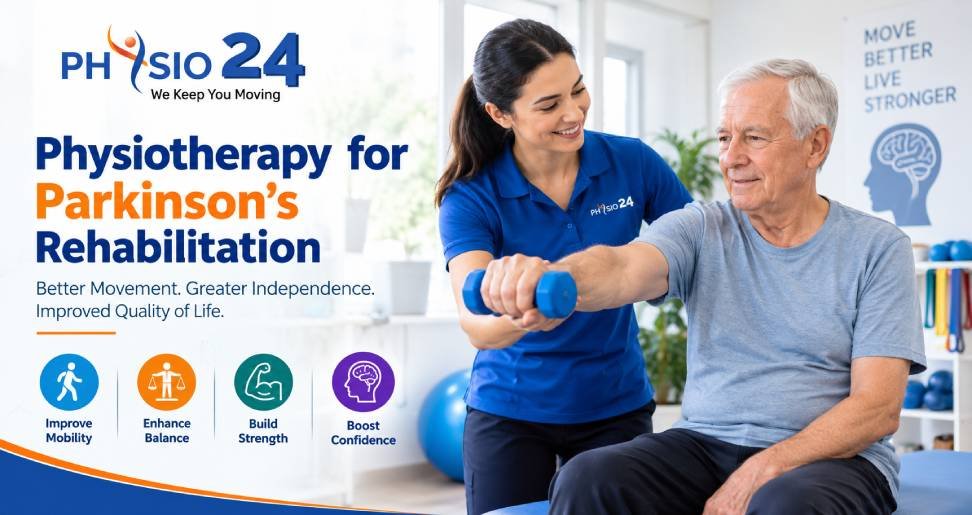
Parkinson’s disease is a progressive neurological condition that can affect movement, balance, coordination, posture, muscle control, and everyday independence. While medical treatment plays an important role in managing the condition, rehabilitation is also essential for helping individuals remain active and function as safely as possible.
Physiotherapy for Parkinson’s Disease can provide structured movement training, therapeutic exercises, balance activities, gait practice, and functional rehabilitation based on an individual’s abilities and goals. With consistent professional guidance, physiotherapy can help people manage movement-related challenges and maintain their quality of life.
For people looking for specialised rehabilitation support, Physio 24 provides neurological physiotherapy and rehabilitation services in Kolkata, including dedicated physiotherapy for Parkinson’s disease.
Understanding Parkinson’s Disease
Parkinson’s disease primarily affects the nervous system and can gradually influence the way a person moves and performs daily activities. Common movement-related symptoms may include tremors, stiffness, slower movements, reduced balance, changes in walking patterns, and difficulties with posture.
Some individuals may also experience reduced physical activity because movement becomes more challenging. Over time, this can contribute to muscle weakness, reduced flexibility, decreased endurance, and greater difficulty completing everyday tasks.
Because symptoms and progression can vary significantly from person to person, rehabilitation should be personalised rather than based on a standard exercise programme.
How Physiotherapy Helps Parkinson’s Rehabilitation
Physiotherapy focuses on maintaining movement, improving physical function, and developing practical strategies that support independence. A physiotherapist can assess the individual’s movement patterns and create an exercise and rehabilitation plan based on their specific needs.
1. Improving Strength and Flexibility
Reduced movement can contribute to stiffness and weakness. A personalised exercise programme can help maintain muscle strength, joint mobility, flexibility, and physical endurance.
Exercises may include controlled strengthening movements, stretching, active range-of-motion exercises, and functional activities. The intensity and complexity can be adjusted according to the person’s abilities.
Regular movement is particularly important because prolonged inactivity may make everyday tasks more difficult.
2. Supporting Better Balance
Balance difficulties can increase the risk of trips and falls among people with Parkinson’s disease. Physiotherapy can incorporate exercises designed to challenge balance safely and progressively.
Training may include weight shifting, controlled reaching, standing exercises, turning practice, and functional movement activities.
The aim is not simply to improve balance in a treatment room but to help individuals develop safer movement strategies for everyday situations.
3. Improving Walking and Gait
Changes in walking are common in Parkinson’s disease. A person may develop shorter steps, slower walking speed, difficulty turning, or problems initiating movement.
Physiotherapy can include gait rehabilitation designed around the individual’s specific difficulties. This may involve practising step length, walking rhythm, direction changes, transfers, and safe use of mobility aids when necessary.
Repeated practice can help patients become more aware of their movement patterns and develop appropriate strategies for walking more safely.
4. Maintaining Posture and Mobility
Postural changes may develop as Parkinson’s disease progresses. A forward-flexed posture can affect balance, comfort, and functional movement.
Physiotherapy can include posture awareness, mobility exercises, stretching, strengthening, and functional movement training. These activities can help patients work toward maintaining more efficient movement patterns.
Posture-focused rehabilitation can also be integrated into everyday activities rather than being limited to formal exercise sessions.
5. Improving Functional Independence
One of the most valuable aspects of neurological rehabilitation is its focus on everyday activities.
A physiotherapist may work with a patient on practical movements such as:
- Getting up from a chair
- Turning safely
- Walking around the home
- Climbing steps
- Reaching for objects
- Getting in and out of bed
- Improving general mobility
- Performing household activities
The objective is to make rehabilitation relevant to real-life needs. Improving a patient’s ability to perform daily activities can contribute to greater confidence and independence.
Exercise and Parkinson’s Rehabilitation
Exercise is an important component of Parkinson’s rehabilitation. However, exercises should be appropriate for the individual’s physical condition, symptoms, balance ability, and treatment goals.
A physiotherapist may recommend a combination of mobility exercises, strengthening activities, balance training, walking practice, flexibility exercises, and functional movement.
Consistency is often more valuable than attempting excessively difficult exercises. A structured programme can also be adjusted as the person’s condition and capabilities change.
The Role of Manual Therapy
Manual Therapy may be incorporated into a broader rehabilitation programme when clinically appropriate. Hands-on techniques can sometimes be used to address musculoskeletal stiffness or movement restrictions.
However, manual treatment should complement active rehabilitation rather than replace therapeutic exercise and functional training.
At Physio 24, manual therapy is among the available rehabilitation services, alongside neurological rehabilitation and other physiotherapy approaches.
Chiropractic, Osteopathic Manipulation and Parkinson’s Rehabilitation
People researching rehabilitation may also encounter Chiropractic and Osteopathic Manipulation. These are different approaches from conventional physiotherapy and are generally more closely associated with musculoskeletal assessment and hands-on treatment.
Chiropractic may involve hands-on techniques intended to address musculoskeletal movement and function. Osteopathic Manipulation may use mobilisation, stretching, or other manual techniques to address selected movement restrictions.
For someone with Parkinson’s disease, the suitability of any hands-on technique should be determined through professional assessment. These approaches should not be considered replacements for a structured neurological rehabilitation programme.
Physio 24 lists Chiropractic and Osteopathic Manipulation among its treatment approaches and combines these services with broader physiotherapy and rehabilitation care.
Can Dry Needling Be Part of Rehabilitation?
Dry Needling is another technique that patients may encounter when exploring physiotherapy services. It uses fine needles applied to selected muscles or soft tissues and may be considered for particular muscular problems.
Dry Needling is different from neurological physiotherapy and is not a treatment for Parkinson’s disease itself. If muscular tightness or a related musculoskeletal problem is present, a qualified professional may determine whether it is appropriate as part of a broader treatment plan.
Physio 24 offers Dry Needling with Electro Therapy as one of its services.
Why Choose Physio 24 for Parkinson’s Rehabilitation?
Finding appropriate neurological rehabilitation is important when Parkinson’s disease begins affecting walking, balance, posture, strength, or independence.
Physio 24 provides neurological rehabilitation in Kolkata and specifically lists Physiotherapy for Parkinson’s Disease among its services. Its wider rehabilitation offering includes Manual Therapy, Dry Needling, Chiropractic and Osteopathic Manipulation, therapeutic tapping, and other physiotherapy services.
For individuals seeking professional Neurological Physiotherapy in Kolkata, a personalised assessment can help identify current movement limitations and establish realistic rehabilitation goals.
Physio 24 also provides clinical and home-care services, which may be useful for people who experience difficulty travelling regularly for rehabilitation.
When Should Someone Consider Physiotherapy?
Physiotherapy can be considered when Parkinson’s-related symptoms begin affecting everyday movement, walking, balance, posture, or physical activity.
Professional assessment may be particularly useful when someone experiences:
- Increasing difficulty walking
- Frequent balance problems
- Reduced physical activity
- Muscle stiffness
- Difficulty standing from a chair
- Changes in posture
- Reduced confidence while moving
- Challenges with everyday activities
Early professional guidance can help establish appropriate movement and exercise strategies before physical limitations become more restrictive.
Building a Long-Term Rehabilitation Routine
Parkinson’s rehabilitation is generally not about achieving a quick result. It is about supporting movement and physical function over time.
A successful rehabilitation routine may combine physiotherapy sessions with appropriate home exercises, regular physical activity, walking practice, balance exercises, and lifestyle adjustments. Family members or caregivers can also play an important role by supporting safe exercise and encouraging consistent participation.
The rehabilitation programme should evolve as the individual’s symptoms, abilities, and goals change.
Conclusion
Parkinson’s disease can create significant challenges involving movement, balance, posture, walking, and independence. Physiotherapy provides an important rehabilitation approach by focusing on strength, flexibility, balance, gait, functional movement, and long-term physical activity.
Techniques such as Manual Therapy, Chiropractic, Osteopathic Manipulation, and Dry Needling may have a role in selected situations, but they should be used according to individual assessment and should complement an appropriate rehabilitation programme.
For people searching for Neurological Physiotherapy in Kolkata, Physio 24 offers specialised neurological rehabilitation and dedicated Physiotherapy for Parkinson’s Disease. With personalised assessment, structured exercise, professional guidance, and consistent rehabilitation, individuals with Parkinson’s disease can work toward maintaining mobility, confidence, and independence for as long as possible.


Leave a Reply
You must belogged in to post a comment.