


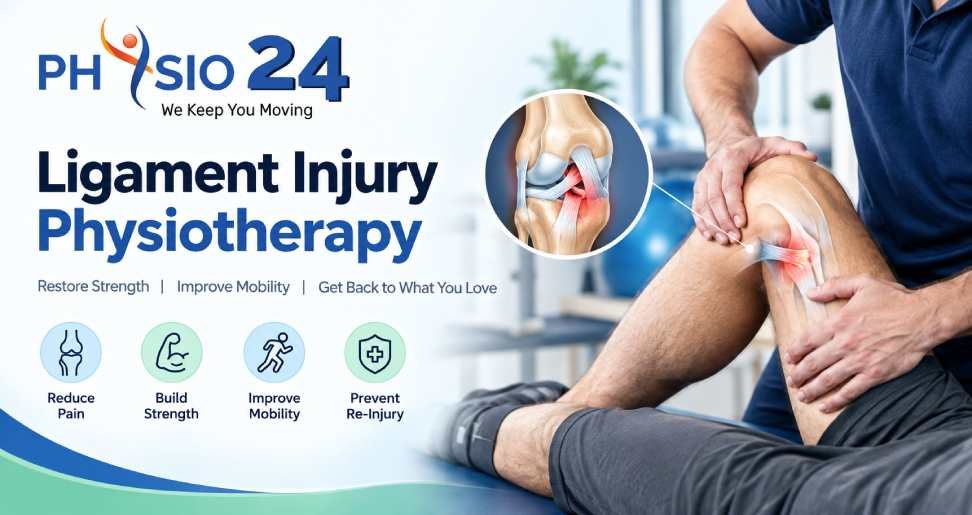
Ligament injuries are common among athletes, active individuals, and even people who experience sudden falls or awkward movements during everyday activities. From a mild sprain to a serious tear, ligament damage can cause pain, swelling, instability, and difficulty moving the affected joint. Without proper rehabilitation, an untreated ligament injury may continue to affect strength and mobility.
Ligament injury physiotherapy can play an important role in reducing symptoms, restoring joint function, improving muscle strength, and helping individuals safely return to their normal activities. A personalised rehabilitation programme can also reduce the risk of future injury.
For people seeking professional rehabilitation support in Kolkata, Physio 24 provides physiotherapy and rehabilitation services designed around individual needs and functional goals.
What Is a Ligament Injury?
Ligaments are strong bands of connective tissue that connect bones and help stabilise joints. They are found throughout the body, including the knee, ankle, shoulder, wrist, and elbow.
A ligament injury occurs when the ligament is stretched beyond its normal range or partially or completely torn. Ligament injuries are commonly classified as:
- Grade 1: Mild stretching with minimal tissue damage.
- Grade 2: Partial ligament tearing, often associated with pain, swelling, and reduced stability.
- Grade 3: Complete ligament rupture, which may cause significant joint instability.
The severity and location of the injury determine the appropriate treatment and rehabilitation approach.
Common Causes of Ligament Injuries
Ligament injuries can occur during sports, exercise, work, or everyday activities. Common causes include:
- Sudden twisting of a joint
- Falls or awkward landings
- Direct impact or collision
- Rapid changes in direction
- Sports-related accidents
- Overstretching of a joint
- Poor balance or muscle control
Knee ligament injuries, particularly ACL injuries, are frequently associated with sports involving jumping, pivoting, running, and sudden directional changes.
Symptoms of a Ligament Injury
Symptoms vary depending on the ligament involved and the severity of the injury. Common signs include:
- Pain around the affected joint
- Swelling or inflammation
- Bruising
- Joint stiffness
- Reduced range of motion
- Difficulty walking or bearing weight
- A feeling of instability
- Weakness around the joint
- A popping sensation at the time of injury
A significant injury should be professionally assessed rather than diagnosed solely based on symptoms.
How Can Ligament Injury Physiotherapy Help?
The primary goal of physiotherapy is to restore safe and effective movement while gradually rebuilding strength and joint stability. Treatment is generally adjusted according to the injury’s severity, stage of healing, and individual goals.
1. Initial Assessment
A physiotherapist may assess pain, swelling, range of motion, muscle strength, joint stability, movement patterns, and functional limitations.
This assessment helps determine an appropriate rehabilitation plan and whether further medical evaluation or imaging may be necessary.
2. Pain and Swelling Management
During the early stage, treatment may focus on managing pain and swelling while protecting the injured ligament. Depending on the condition, physiotherapy may incorporate appropriate modalities, movement strategies, and education about activity modification.
The aim is to allow healing while avoiding unnecessary stress on the injured tissue.
3. Restoring Joint Mobility
Injury can make a joint stiff and difficult to move. Once appropriate for the stage of healing, carefully selected mobility exercises can help restore the joint’s available range of motion.
Exercises should be progressed gradually rather than forcing painful movement.
4. Strengthening the Supporting Muscles
Muscle weakness is common after ligament injuries because pain and reduced activity can limit normal movement.
A rehabilitation programme may progressively strengthen muscles surrounding the injured joint. For knee ligament injuries, this can include exercises targeting the quadriceps, hamstrings, glutes, and calf muscles.
Improving muscular strength can contribute to better joint control and functional movement.
5. Balance and Proprioception Training
Ligaments contribute to joint stability and proprioception—the body’s awareness of joint position. After an injury, balance and coordination may be affected.
Physiotherapy can introduce progressive balance and proprioceptive exercises to help the individual regain control of the affected joint.
6. Functional and Sport-Specific Rehabilitation
Returning to normal activity should be gradual. For athletes, rehabilitation may eventually include running drills, jumping, landing mechanics, agility exercises, and sport-specific movements.
The objective is not simply to make the joint feel better but to improve strength, control, confidence, and functional capacity before returning to demanding activities.
ACL Injury and Rehabilitation
The anterior cruciate ligament (ACL) is one of the major stabilising ligaments of the knee. ACL injuries can occur during sudden stops, changes in direction, awkward landings, or contact sports.
Some ACL injuries may be managed conservatively, while complete tears in certain active individuals may require surgical reconstruction. Rehabilitation is important in both situations.
For people recovering after surgery, ACL Reconstruction Rehabilitation can help restore mobility, strength, balance, and functional movement through appropriately progressed exercises.
The rehabilitation timeline varies considerably depending on the injury, treatment approach, surgical procedure where applicable, individual recovery, and functional goals.
Manual Therapy, Dry Needling and Other Approaches
A comprehensive rehabilitation programme may sometimes incorporate additional physiotherapy techniques depending on the individual’s presentation.
Manual Therapy may be used where appropriate to address joint or soft-tissue mobility and support movement during rehabilitation.
Dry Needling can sometimes be incorporated to address muscular tightness or related pain as part of a broader treatment programme.
Some patients may also explore Chiropractic or Osteopathic Manipulation for musculoskeletal concerns. These approaches are not substitutes for a structured ligament rehabilitation programme, and their suitability depends on the individual’s condition and clinical assessment.
At Physio 24, these treatment approaches can form part of a broader evidence-informed physiotherapy strategy when clinically appropriate. The clinic provides physiotherapy, manual therapy, osteopathic and chiropractic adjustment, dry needling, therapeutic tapping, and pre- and post-surgical rehabilitation.
When Should You See a Physiotherapist?
Professional assessment is advisable if pain, swelling, instability, or restricted movement persists after an injury.
You should particularly consider assessment if:
- You cannot put weight on the affected limb.
- The joint repeatedly gives way.
- Swelling is significant or persistent.
- You heard or felt a pop during the injury.
- Normal movement remains restricted.
- You are unable to return to everyday activities.
- You are recovering from ligament surgery.
Severe injuries may require evaluation by a doctor or orthopaedic specialist before or alongside physiotherapy.
Why Choose Physio 24 for Ligament Rehabilitation?
Effective rehabilitation requires more than simply performing exercises. The programme should match the person’s injury, current physical capacity, lifestyle, and recovery objectives.
Physio 24 provides physiotherapy care in Kolkata, including orthopaedic and sports injury rehabilitation. Its clinical services include manual therapy, ACL reconstruction rehabilitation, dry needling, therapeutic tapping, and pre- and post-surgical rehabilitation.
The clinic is located at Bangur Avenue, VIP Road, Kolkata, and also provides home-care services.
Conclusion
Ligament injuries can affect movement, strength, stability, and confidence, but appropriate rehabilitation can support a safe return to everyday activities and sport. Ligament injury physiotherapy focuses on progressive recovery—from managing pain and restoring mobility to rebuilding strength, balance, joint control, and functional capacity.
Whether you are recovering from an ankle sprain, knee ligament injury, or ACL reconstruction, an individualised rehabilitation programme can make an important difference. With professional assessment and consistent rehabilitation, patients can work towards stronger movement and improved confidence in the injured joint.
For individuals looking for physiotherapy and rehabilitation support in Kolkata, Physio 24 offers a range of treatment and rehabilitation services tailored to different musculoskeletal and sports-related conditions.


Leave a Reply
You must belogged in to post a comment.